
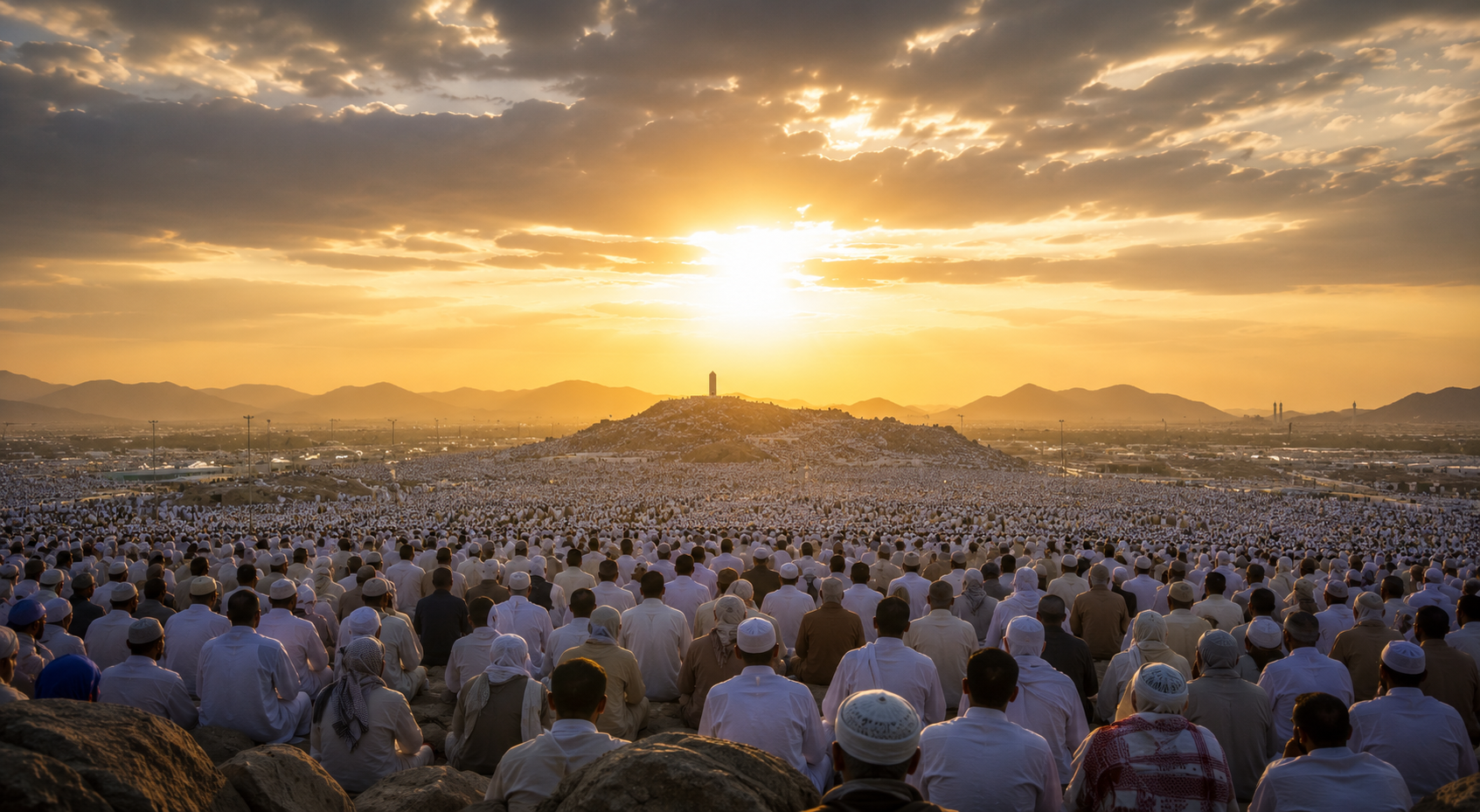
Every year, the Day of Arafah gathers the hearts of Muslims around one of the most concentrated moments in sacred time. The Prophet ﷺ said, “Hajj is Arafah.” Other ahadith also tell us that there is no day on which Allah frees more people from the Fire than this day. Furthermore, it was on Arafah, during the farewell pilgrimage, that the verse “Today I have perfected your religion for you” [5:3] was revealed. Arafah, then, is not only a station of dua, but a station of completion, mercy and moral clarity.
That clarity shines through the Prophet’s ﷺ final sermons during the farewell pilgrimage. In them, he ﷺ did not give the ummah slogans. He ﷺ gave them sacred limits. Amongst them, there is one that we are in desperate need of deeply reflecting upon today.
The Prophet ﷺ declared that Muslim blood, wealth and honour are inviolable. He ﷺ was tearing down every barrier that divided people and rebuilding the Ummah upon faith, brotherhood and unity. It was as though he was saying, leave behind your pride, your tribalism, your divisions and your hatred, for you are all one Ummah under Allah. He ﷺ was teaching us that unity is not merely slogans or emotions, rather it requires protecting one another’s dignity. It means not humiliating others through backbiting, slander, gossip or public shaming. The tongue can divide hearts faster than anything else, and so the Prophet ﷺ reminded this Ummah that the sanctity of a Muslim’s honour must be protected just as their blood and wealth are protected.
That is why one of the most searching warnings in the final sermon is: “Do not return to being disbelievers, killing one another.” Division, in the Prophetic vision, is not first an intellectual problem. It is a moral and spiritual collapse that turns disagreement into desecration and brothers into enemies. The final sermon does not merely tell Muslims to feel united. It gives them the conditions of unity: honour life, respect property, guard dignity, fulfil trusts, and do not spill one another’s blood.
The Qur’an deepens this further by giving us one of its most astonishing descriptions of Prophet Ibrahim, “Indeed, Ibraham was an ummah.” [16:120] One man is called an ummah. Why? Not because he shouted slogans, but because he acted. He remained firm when everything around him pushed him to compromise. He stood alone when justice was unpopular. He sacrificed when others clung to comfort. He trusted Allah when the path ahead seemed impossible. That is why Allah called him an Ummah. Not because he had followers or power, but because one sincere servant carrying truth, justice and conviction can outweigh entire nations that have lost their moral compass. He became the source of a believing people.
Today, many feel overwhelmed by division, sectarianism, racism, tribalism, political rivalries, nationalism and ego. We have allowed labels, backgrounds and differences to become barriers between hearts that are supposed to be connected by faith.
And so, on the day of Arafah, we reflect and see that this blessed day carries the fragrance of Prophet Ibrahim as much as the tears of Prophet Muhammad’s ﷺ ummah. Prophet Ibrahim raised the foundations of the House with Isma’eel. He was made an imam for humanity. He prayed that hearts would incline towards the sacred Ka’bah and that prayer would be established there. Then, in the farewell pilgrimage, the Prophet ﷺ gathered Muslims of every language and colour in that same Ibrahimic landscape and declared that the true measure of human worth is not race, tribe, or lineage.
“O people, your Lord is one, and your father Adam is one. There is no superiority of an Arab over a non-Arab, nor a non-Arab over an Arab, and neither white skin over black skin, nor black skin over white skin, except by taqwa.”
In a world deeply divided by tribe, race, lineage and social status, these words of the Prophet Muhammad ﷺ were nothing short of revolutionary. Seventh-century societies were built upon superiority and exclusion. Every civilisation believed itself to be greater than others. Honour was tied to bloodline, colour, wealth or ethnicity, and entire groups of people were viewed as inferior simply because of who they were. Against this backdrop, the Prophet ﷺ stood before humanity and declared a principle that shattered centuries of arrogance and division, that all people are equal before Allah, and that no person holds superiority over another except through taqwa (consciousness and obedience to Allah). This was not merely a spiritual statement, it was a complete transformation of how humanity viewed itself. The Prophet ﷺ dismantled those barriers and established a vision of the Ummah rooted not in race or nationality, but in brotherhood, justice and shared devotion to Allah.
From here, the lesson for our own age becomes painfully clear. Muslim unity will not be restored by rhetoric that ignores the diseases of contempt, rivalry and reckless speech. The Qur’an says, “Hold firmly together to the rope of Allah and do not be divided.” [3:103] It says the believers are brothers and commands them to make peace. The Prophet ﷺ said, “A Muslim is the brother of a Muslim, he does not wrong him, abandon him, or belittle him”. Unity, then, is not the denial of all difference, but the discipline of remaining bound to revelation while refusing to let difference harden into hatred, excommunication or moral humiliation.
The Qur’an rebukes those who split their religion into sects and describes fractured communities as parties, each rejoicing in what it possesses. Another hadith likens believers to a building whose parts strengthen one another. Taken together, these texts move the question of unity away from branding and towards duty. Do we protect one another’s honour? Do we tell the truth about one another? Do we refuse the thrill of takfir, mockery and humiliation? Do we build, or do we fracture?
On this blessed Day of Arafah, these are not abstract questions. They are questions to ask with raised hands and a trembling heart. Before we speak about healing the ummah, we should ask Allah to heal the fractures within our own souls: arrogance, resentment, tribal pride and the love of being right more than the love of being reconciled. The Prophet ﷺ left us the Book of Allah and warned us against division. Ibrahim showed us what one heart, fully surrendered, can mean for generations. Arafah invites us back to both: to revelation with humility, and to one another with mercy.