
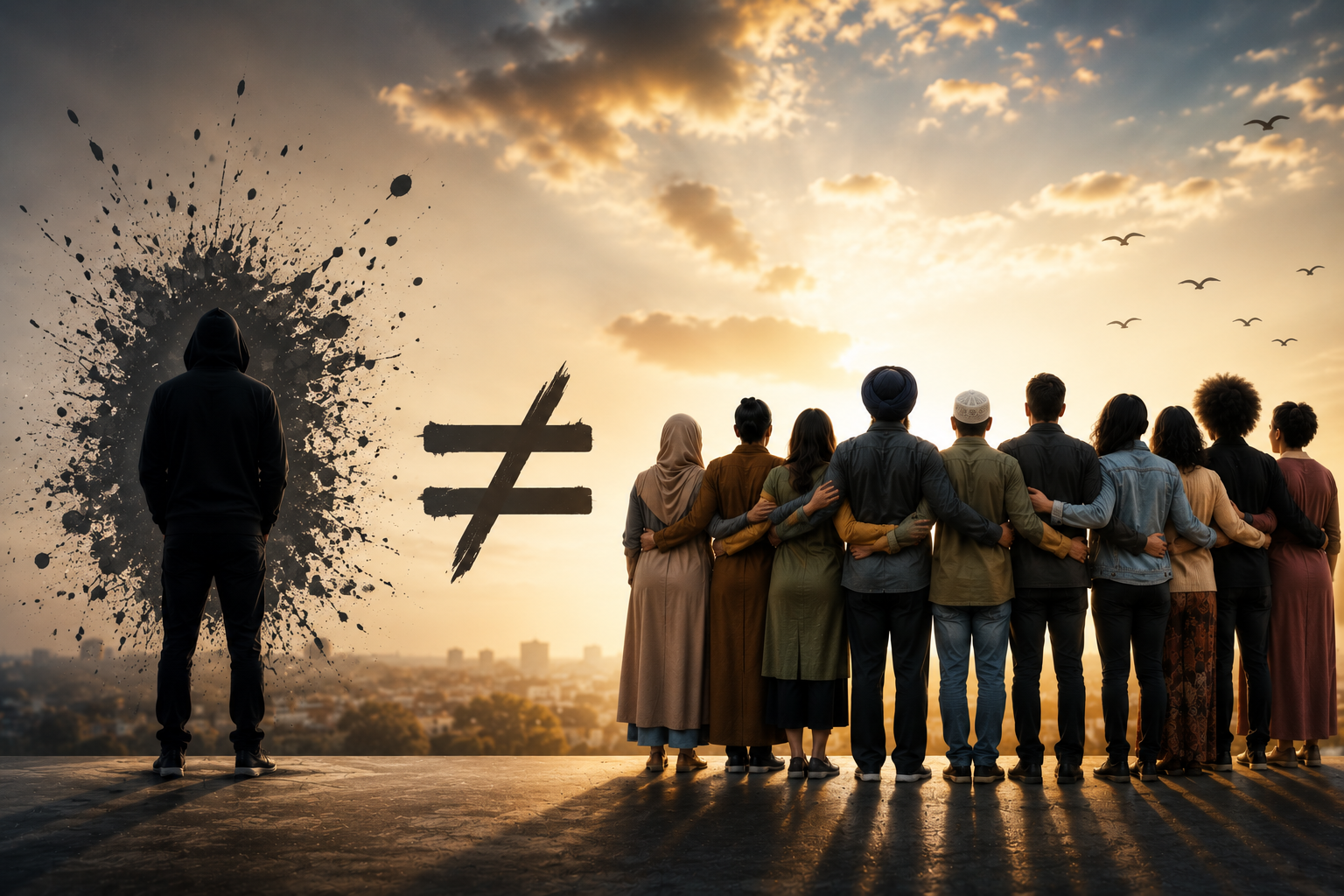
One of the most dangerous phenomena of our time is the tendency to blame entire communities for the actions of an individual. It is a habit that has perhaps existed throughout history, but in today’s interconnected world it spreads faster, travels further and causes deeper harm than ever before. We see a terrible crime committed by one person and, almost immediately, questions begin to be asked about the wider community to which that individual belongs. Suspicion spreads, fear grows and stereotypes are reinforced. Millions of innocent people suddenly find themselves viewed through the lens of somebody else’s actions.
For many Muslims, this experience is painfully familiar. Following the attacks of 9/11, countless Muslims around the world found themselves forced into a position where they were expected to apologise for, explain or distance themselves from acts they had absolutely nothing to do with. Ordinary people who simply wanted to live peaceful lives suddenly became representatives for an entire faith of nearly two billion people. Teachers, doctors, taxi drivers, shopkeepers, students and community volunteers all found themselves judged not by their own character, but by the actions of criminals they had never met. The logic was absurd then, and it remains absurd today.
More recently, we have seen members of the Sikh community facing hostility following the tragic murder of Henry Nowak. Once again, the actions of an individual have led some to blame an entire community. Once again, innocent people have found themselves having to answer for something they neither supported nor participated in. The pattern is always the same. Whereas, when an individual commits a crime, the focus should be on the individual. When a group is blamed, the focus shifts away from justice and towards prejudice.
The irony is that we rarely apply this standard consistently. If one member of a community commits a crime, suddenly that community is scrutinised. Yet when individuals from other backgrounds commit offences, society generally recognises them as exactly what they are: individuals or ‘lone wolfs’. This selective application of collective blame reveals something deeper. Often, these moments expose prejudices that already existed beneath the surface.
Most people are fair-minded and refuse to fall into such traps. Most people understand that guilt belongs to those who commit wrongdoing and nobody else. However, there are always those waiting for an opportunity to validate beliefs they already hold. Rather than seeing a crime as the act of an individual, they use it as evidence for assumptions they have quietly carried for years. They seize upon isolated incidents to justify broader hostility towards entire groups. The reality is that prejudice rarely announces itself openly. In modern society, overt racism is increasingly unacceptable. As a result, some individuals seek moments that allow them to dress prejudice in the language of concern, security or public interest.
The target changes, but the mechanism remains the same. Sometimes it is Muslims. Sometimes it is Sikhs. Sometimes it is Jews. Sometimes it is migrants. Sometimes it is Black communities. Sometimes it is another group entirely. Yet the process remains identical: take the actions of one person and project them onto millions. The consequences are devastating. Trust between communities weakens. Neighbourhoods become more divided. Children grow up feeling that they are viewed as outsiders. People begin to retreat into their own circles, fearful of how they will be perceived. The social fabric that holds communities together starts to unravel.
What makes this even more concerning is that division often benefits those who hold power. When ordinary people are busy blaming one another, they are less likely to scrutinise the institutions, policies and decision-makers that shape their lives. History teaches us that divided communities are easier to manage than united ones. When working-class communities, faith groups and minority communities become suspicious of one another, attention is diverted away from issues such as poverty, inequality, housing, education and public services. Instead of asking difficult questions of those in authority, people end up fighting amongst themselves. That serves nobody except those who benefit from division.
Yet despite all of this, there is another reality that rarely makes headlines. It is the reality of everyday people. The reality of neighbours helping neighbours. The reality of communities quietly serving one another. Here in Huddersfield, I have witnessed this reality time and time again. I have seen Muslims, Sikhs, Christians, people of no faith and many others come together to serve the wider community without asking who someone voted for, what religion they followed or where they came from.
For years, through our Friday Hot Meals service, volunteers and supporters from different backgrounds have worked side by side with one shared purpose: helping those in need. Together, we have distributed more than 25,000 meals. Those meals were not prepared by one community. They were prepared by a community of communities. The volunteers who gave their time came from different faiths and different backgrounds. The donors who supported the work came from different faiths and different backgrounds. The people receiving those meals came from different faiths and different backgrounds. Nobody stopped to ask whether the person receiving help belonged to the same religion, ethnicity or culture as them. They simply saw another human being in need and responded with compassion.
Perhaps that is the lesson we need now more than ever. The overwhelming majority of people are decent. The overwhelming majority of people want peaceful communities. The overwhelming majority of people are simply trying to raise their families, contribute positively and live meaningful lives. We should not allow the actions of a few to define the many. Every community has people who do extraordinary good. Every community has people who make mistakes. Every community has individuals who commit terrible acts. That is the reality of humanity.
If we continue judging millions by the actions of one person, we will only create more division, more resentment and more misunderstanding. The answer is not collective blame. The answer is collective responsibility. The responsibility to challenge prejudice wherever it appears. The responsibility to defend communities when they are unfairly targeted. The responsibility to stand together even when others seek to pull us apart. In the end, the future of our communities will not be determined by those who spread fear. It will be determined by those who choose unity over division and humanity over hatred.