
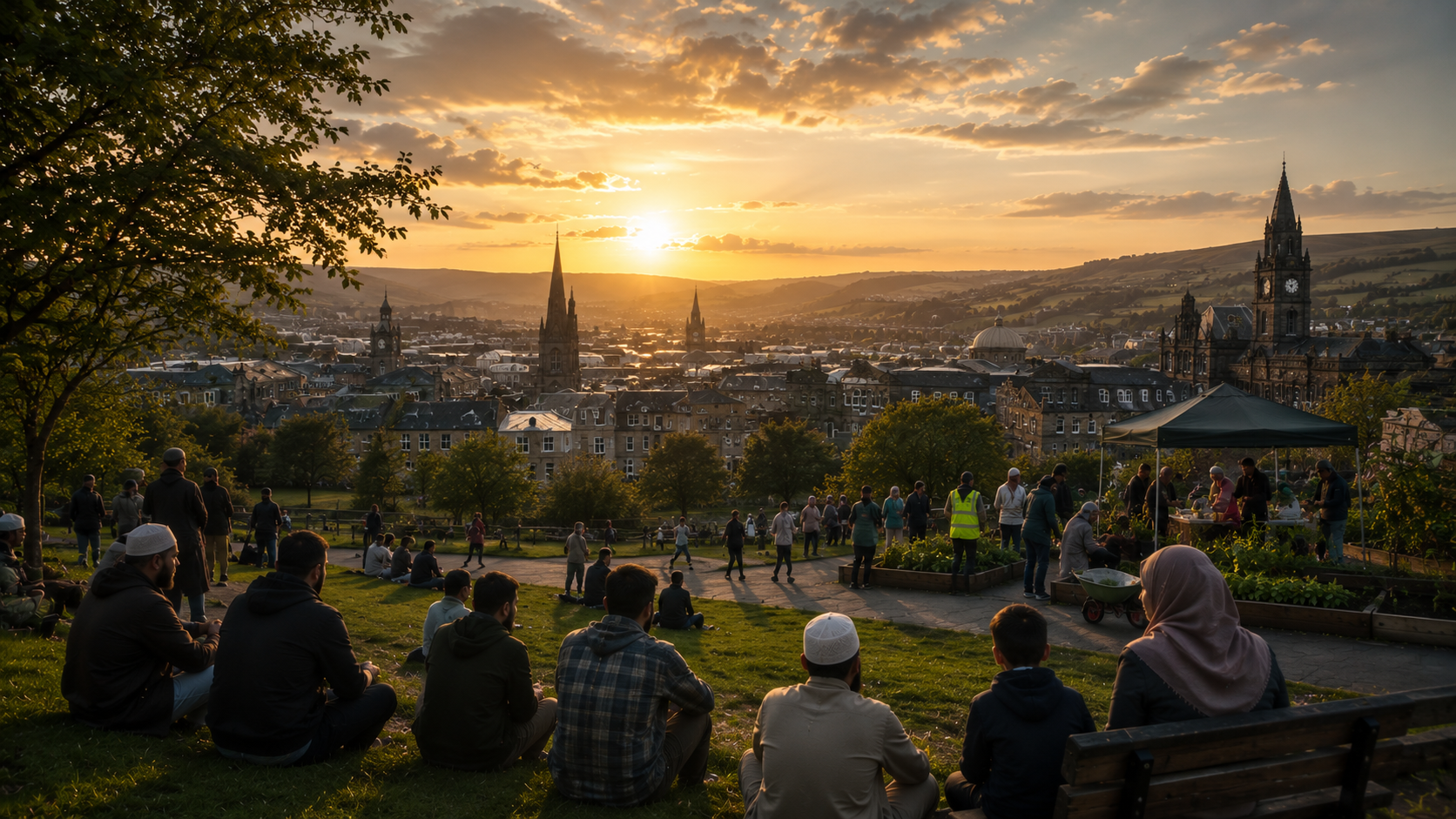
Having spent the last decade serving the Muslim community in a variety of local and national roles; as an imam, headteacher of a madrassah, working to bring masjids together, representing Islam at civic and interfaith events, engaging in political advocacy to safeguard the interests and identity of British Muslims, and leading numerous community initiatives, I hope my words are received in the spirit they are intended.
They do not come from a place of negativity or a desire to criticise for the sake of criticism. Rather, they come from genuine concern, lived experience, and a sincere commitment to seeing our communities, institutions and leadership flourish. We cannot grow if we are unwilling to reflect honestly on our situation, and constructive feedback should always be viewed as an opportunity for improvement.
We speak a lot about the Ummah and use the word often. For many, we feel proud of being a part of this Ummah. But the Qur’an and Sunnah do not present the ummah as a title we inherit and then leave sitting on a shelf. Allah calls us to brotherhood, to organised goodness and to cooperation in righteousness. The Prophet ﷺ taught us that believers are like one body and like one building, each part supporting the next. The Prophetic model in Madinah was not built on slogans, birth-right or tribal pride. It was built on responsibility, covenant and care for the wider community. That is what it means to be an ummah: not just to belong by name, but to serve by action.
In Huddersfield alone, our community numbers well over 30,000 Muslims. We are not a small or insignificant minority. We have the numbers, the talent, the resources and the potential to be a powerful force for good. Yet, at times, it feels as though we choose to remain invisible. The spirit of being a collective ummah is absent from our reality.
The issue is not a lack of people. It is not a lack of ability. The real question is whether we care enough to translate our faith into meaningful action. Because when community work needs doing, when local problems need facing, when the wider society needs Muslim presence, Muslim confidence and Muslim service, too often we do not step forward in the way we should.
Today, the British Muslim community is facing serious pressures and challenges. We have lower employment rates than the UK average. Poverty is hitting Muslim households especially hard. Islamophobia and anti-Muslim hate crime is at an alarmingly high level and remains a real and documented problem. Just yesterday, a far-right terror plot against the Tablighi Ijtima in Ipswich was thwarted by the police. Numerous masjids, including in our town, have faced violence. Muslims sisters in Huddersfield have messaged me sharing stories of how they have been targeted in hate crimes. Our young people are being dragged into gangs and lives of crime. And so, this is not a time for withdrawal, silence or self-absorption. It is a time for maturity, service and leadership.
Yet when it comes to interfaith work, political engagement, civic engagement, humanitarian issues, anti-racism, and standing up to Islamophobia, too often it feels like we see the same few faces again and again. Meanwhile, many of us who stay away from the work on the ground still find time to sit back and criticise those who are actually fighting for us. That is not sincerity. That is not brotherhood. And that is certainly not the Prophetic model. Huddersfield has interfaith and civic spaces that are open and active, and they need more Muslim presence, not less.
On more than one occasion, I have personally pleaded with members of our community, and with local ulama as well, about certain local challenges. Too often, it has felt like those pleas have fallen on deaf ears. Too often, there has seemed to be little real concern beyond our own immediate circles.
It seems we have become too comfortable with “me, my masjid, my project, my organisation”. Too often, we behave as though the local ummah is somebody else’s responsibility. Too often, masjids and organisations act like little fiefdoms, protecting territory instead of building trust, and at times even seeming more comfortable with someone else’s failure than with a shared success. If that sounds harsh, it is only because the situation is serious. A community cannot stay healthy if every part is only protecting itself.
I am not painting everyone with the same brush. There are organisations, masjids, imams, activists, volunteers, and ordinary brothers and sisters in Huddersfield who are genuinely trying. Some are carrying a burden far heavier than most people realise. Some Muslim women and community workers across the UK are repeatedly at the forefront of interfaith and local community initiatives despite facing hostility themselves. They deserve support, not cheap shots from the sidelines.
History should disturb us enough to wake us up. Muslim rule in al-Andalus lasted for nearly eight centuries, and historians do not say it ended for one reason alone. But they are clear that fragmentation, infighting and the loss of Muslim unity left the Muslims weaker and easier to defeat. No, I’m not saying that Huddersfield is medieval al-Andalus. But the lesson still stands, when a people become consumed by their own little islands (own little organisations, masjids and groups), and lose the ability to work together for a common good, they put their own future at risk. If we do not learn from history, we should not be surprised when history teaches us the hard way.
So where do we begin? We begin by changing our mindset. We stop asking, “What is in this for me?” and start asking, “What does our town need from us?” We have to stop assuming that community work belongs to a select few. We have to stop treating volunteers like targets for criticism and start treating them like people who need backing. We have to stop making every good effort a competition. And we have to remember that serving the people of Huddersfield, standing for justice, strengthening our families, helping the vulnerable, building bridges and defending our neighbours from hatred are not distractions from Islam and our faith. They are from Islam.
If you want to help but do not know where to start, then start small and start sincerely. Give time, not just opinions. Offer skills, not just commentary. Attend the meetings. Support the charities. Back the youth work. Build ties beyond your own circle. Show up in civic spaces. Stand with those doing anti-racism and anti-Islamophobia work. Support interfaith efforts when they are useful. And if you are unsure where your time could make the most difference, reach out to me and I can point you in the right direction.
May Allah make us a community of substance and action.